On the Frontlines of Dignity

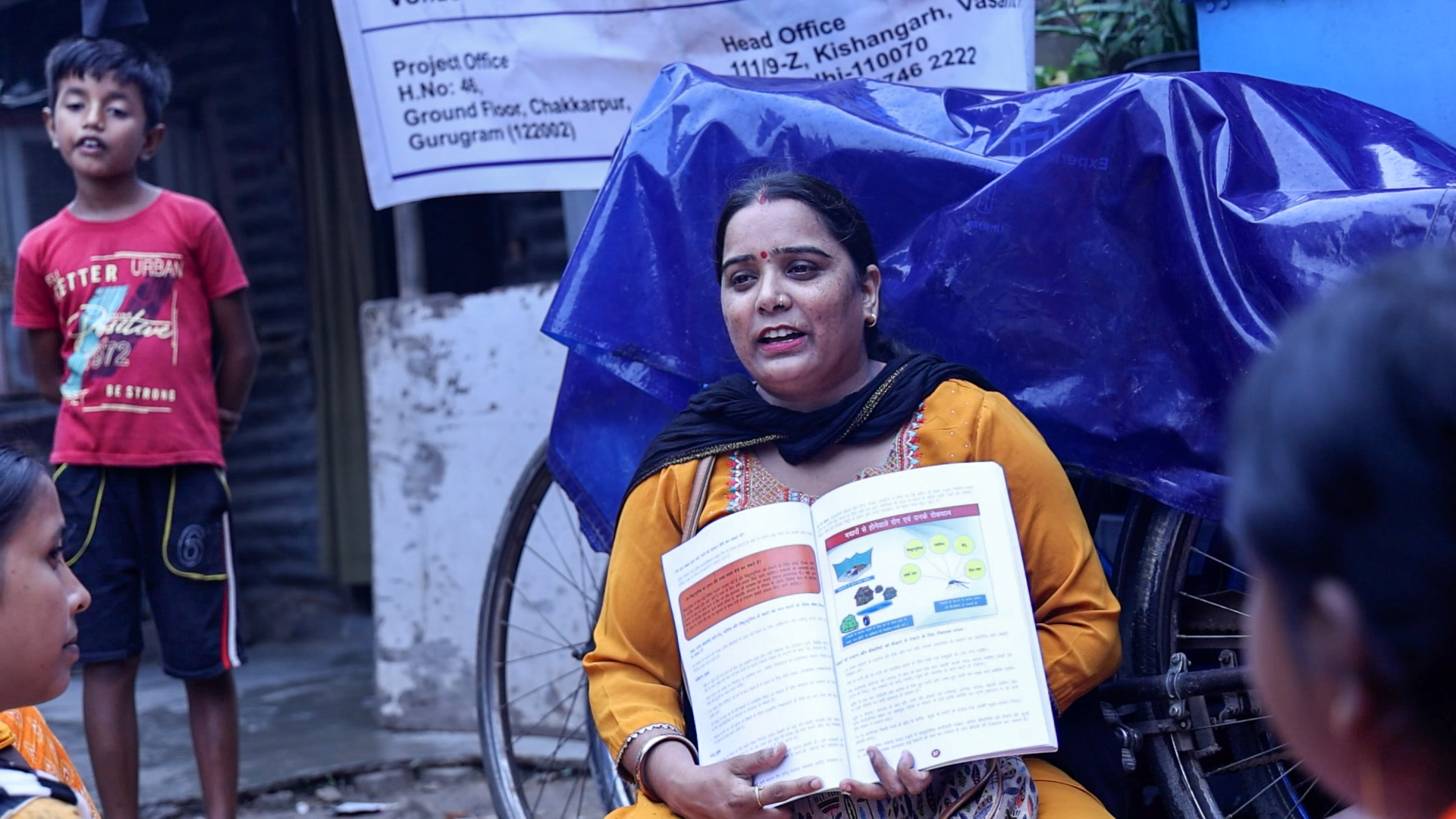
Veena is 28 years old and lives in Gurugram. Every day, she rides her scooter across the city to reach the community where she works as Humana’s Community Mobiliser in Chakkarpur. She has been working with Humana for the past year.
“My name is Veena,” she says. “I studied Arts and Social Sciences for my bachelor’s degree, although I did not complete my graduation. Still, I always knew I wanted to work with people — helping, mobilising, supporting wherever I could. I truly love my job.”
Although she did not finish her degree, her commitment to community work has always been clear. Today, she coordinates ten women’s groups and organises monthly meetings with each of them. “My goal is simple and very personal,” she explains. “I want to help those who are in need.”
Veena understands the realities of migration. Many of the families she works with have moved from different parts of India in search of work and stability. “The government provides support in many ways,” she says, “but migrants often face greater difficulties. They are more vulnerable, more marginalised, and often unaware of their rights or the services available to them.”
She believes deeply in dignity and equality. “Everyone deserves a normal life — a good life — as easy and dignified as possible. Access to information and the possibility of a healthy life are not luxuries; they are human rights.”
Her work fulfils something much deeper within her. “I do this willingly, from the heart,” she admits. “There are nights when I cannot sleep well knowing that so many people still need help.”
Before joining Humana, Veena witnessed harsh realities in slum communities. One incident, in particular, changed her path forever. She recalls seeing a man brutally attacked and burnt. “I felt completely powerless,” she says quietly. “But that was the moment I understood that my path had to be one where I could stand close to people who suffer.”
When she learnt about Humana’s work, she felt she had found the right place. It offered her a safe and meaningful space to begin contributing in a real way — exactly what she had been searching for.
Her main responsibility now is organising monthly meetings with women from the community, where she provides information on health, prevention, hygiene, sanitation, nutrition, and seasonal illnesses. When necessary, she also helps facilitate visits to doctors or medical services. “My only aim,” she says, “is that families can live healthier and more stable lives.”
The challenges in the field are significant. Veena regularly sees families struggling to secure stable work or meet basic needs. One situation that deeply moved her involves two very young girls who long to study but lack the resources to continue their education. “They have dreams,” she says, “but daily survival pushes education aside. It is painful, because they are the future.”
Her work sometimes brings uncomfortable moments. After meetings, she collects signatures from participants. Occasionally, when husbands return home — particularly if they have been drinking — they question her intentions. “They ask why I need signatures and whether I can be trusted,” she explains. Most situations calm down after the women clarify, but there have been times when she has been asked to leave. Despite the tension, she continues her work, supported by her office team and sometimes accompanied when necessary.
Yet amid these challenges, Veena finds immense pride in the women she works with. “Each woman is special in her own way,” she says warmly. Some have started small businesses selling snacks. Others collect recyclable waste to generate income. Conversations about environmental topics like recycling can be difficult when survival is the immediate priority. “They ask, ‘What is the benefit for us?’” she says. “And I understand that question.” Still, she continues these discussions step by step.
There are also moments of real success. One woman from the Durga group completed a beauty training course organised through the programme. When Veena heard about a vacancy in a boutique, she helped connect her. Today, the woman is employed. “She had the skills but not the opportunity,” Veena says proudly. “Moments like that remind me why this work matters.”
For Veena, the process is mutual. “It is not one-sided,” she reflects. “I am learning from them every day.” Many of the women come from different regions, and language can be a barrier. She did not previously know the Bengali language, but through daily interaction, she has picked up some of it — just as the women learn from her.
She manages ten WhatsApp groups, each with 12 to 14 women, to stay connected and share information. After formal discussions, they often remain seated together, talking about personal matters, sharing laughter, tea, fruit, or small meals. Some women bring their toddlers, who sit beside them as conversations unfold.
“These moments create belonging,” Veena says. “They create community.”
Despite the emotional and practical challenges, she remains certain about her path. “It is not always easy,” she reflects, “but it is deeply fulfilling. When I see even a small positive change — a woman becoming more confident, a family becoming more aware, a child gaining better opportunities — I feel my work has meaning.”